Business environment
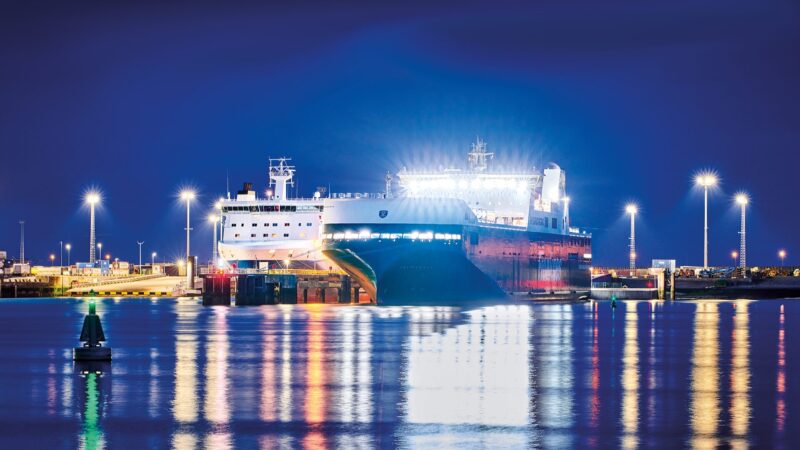
Finnlines operates in the Baltic Sea, the North Sea and the Bay of Biscay, building the future with determination. Finnlines’ key sea routes remained strong and the company continued to focus on sustainable growth.
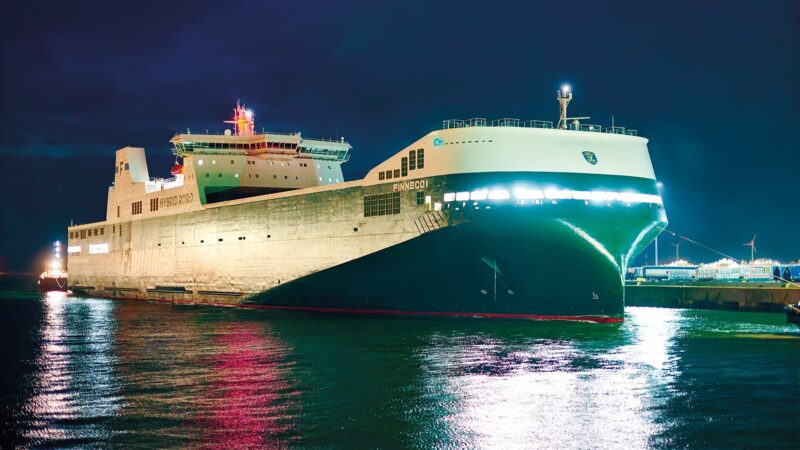
Although the economic downturn since 2022 has softened transport volumes, sea routes between Finland, Germany, Sweden and Poland have remained busy and vital. Poland has rapidly emerged as a significant growth market in the Baltic Sea region. Developing rail connections complement maritime transport and, together, provide a sustainable alternative to road transport.
Geopolitical developments continued to influence route demand and traffic flows. Sanctions on Russian cargo and the restructuring of energy markets are contributing to the redirection of transport volumes to alternative routes.
In Finnlines’ main market area between Finland and Germany, a growth of approximately 3 per cent was recorded when the impacts of the 2024 stevedoring strikes are taken into account. While volumes among customers in the transport and logistics sector have developed positively, Finland’s forest industry experienced a decline in exports and the transport of new cars came to a near standstill.
Environmental regulations are reshaping short sea shipping faster than any other trend. The EU Emission Trading System will be fully applied to maritime transport in the coming year and fuel requirements will continue to gradually tighten. Bio diesel, LNG, bio-LNG, methanol-ready solutions, hybrid vessels and battery technologies are moving from pilot phases toward practical deployment.
The regional security situation is under continuous review. GPS interference and risks associated with the shadow fleet require proactive preparedness. Potential disruptions are mitigated through navigation technologies that utilise multiple satellite systems. Close cooperation with authorities strengthens situational awareness and overall safety.
Economic outlook
According to the International Monetary Fund (World Economic Outlook), the global economy is forecast to grow by 3.3 per cent in 2026, while the euro area is projected to grow by 1.3 per cent.
Germany’s economy has grown sluggishly, but a slow recovery is anticipated. Growth is expected to turn slightly positive in 2025 (0.2 per cent) and strengthen to 1.1 per cent in 2026.
Finland has also experienced slow growth, but the IMF forecasts an economic upturn from 2026 onwards, with GDP expected to grow by 1.3 per cent.
Sweden’s economy has, likewise, seen weak growth, but the recovery is expected to be faster than in Finland, with GDP projected to grow by 1.9 per cent in 2026.
Poland stands out with stable and strong growth, with GDP expected to grow by 3.5 per cent in 2026.
Global inflation is forecast to decline to 3.8 per cent in 2026, while the euro area rate is expected to slow to 1.9 per cent. In Germany, inflation is estimated at 1.8 per cent, compared with 1.9 per cent in Finland and 1.6 per cent in Sweden. Poland’s inflation is projected to fall to 2.8 per cent in 2026.
According to Traficom, imports transported to Finland by sea in containers, lorries and trailer units remained at 10.0 million tonnes in 2025, while exports increased by 5.7 per cent to 16.4 million tonnes. According to Statistics Finland, passenger traffic between Finland and Sweden decreased by 6.6 per cent, while traffic between Finland and Germany remained at 2024 levels.
Sustainable growth
Finnlines’ strengths are reflected in its ability to respond swiftly to change, supported by an agile organisation, an extensive route network and a modern fleet. Together these factors enable the company to meet the evolving requirements of customers in an effective manner.
Customers benefit from Finnlines’ low-emission Green Lane solution, which supports compliance with tightening environmental requirements and enables ambitious energy savings.
Finnlines’ competitive strength is further reinforced by its solid financial position, its owned and modern fleet and its comprehensive route network, all supported by the broad capabilities of its owner, the Grimaldi Group.
Quality 2025
Port operations 2025

Passenger services 2025
Freight services 2025
Our purpose, strategy and values 2025