Environment and safety
Environmental aspects have a pivotal role in Finnlines’ operations. We produce safe and first-class services in a manner that aims to minimise environmental effects.
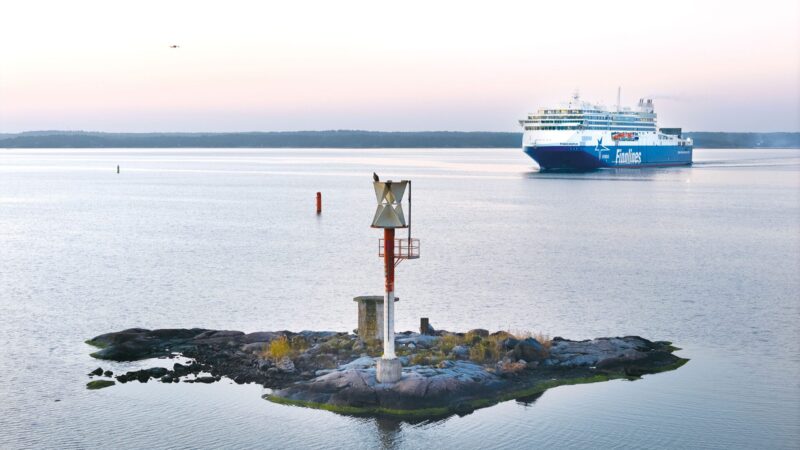
Shipping, which transports around 90 per cent of global trade, provides the principal mode of transport for the supply of raw materials, consumer goods, essential foodstuffs and energy to the global population. The vast majority of these products could not be transported any other way than by ship. The Covid-19 pandemic demonstrated the essential role played by transport and the social, health and economic costs when the free movement of people, goods and services is severely constrained. Finnlines has an essential role in securing Finland’s security of supply and providing connections to key European markets.
The Finnlines’ ro-pax concept combines cargo and passenger traffic, ensuring a high utilisation rate even during seasonal ups and downs. The efficient transport of goods also enables sustainable passenger travel, as the carbon footprint per passenger remains low when the carriage of freight and passengers is combined.
Green transition
In the summer of 2023, the IMO revised its greenhouse gas strategy. Commitment was made to ensure an increasing uptake of alternative zero or near-zero GHG fuels by 2030. Carbon intensity, measured by CO2 emissions per transport work should decrease by 40 per cent by 2030. All target figures are compared with the 2008 level. The target is now aligned with the European Commission’s target for Europe to become a climate-neutral continent by 2050. Both globally and within the European Union, numerous proposals are being discussed and already finalised to combat climate change. To reach the ambitious goals, the shipping sector will have to make the transition to alternative fuels and adopt new technologies.
The EU Commission’s plan to reduce greenhouse gas emissions, the “Fit for 55” package, includes some maritimerelated items.
- From the beginning of 2024, maritime transport has been
included in the Emissions Trading System (ETS). The system
covers CO2e emissions from ships of at least 5,000 GT trading in the EU. As part of the phase-in period, 70 per cent of annual CO2 emissions were included in the ETS in 2025. From next year onwards, all CO2, CH4 and N2O emissions within the scope will be included. - The FuelEU Maritime regulation came into force on 1 January 2025. It sets a maximum limit on the greenhouse
gas intensity of energy used by ships. From 2025 the GHG intensity of the fuel used onboard should be reduced
by 2 per cent. After that the GHG intensity reduction requirement will increase gradually every five years.
Consequently, shipping companies are obligated to start using gradually increasing volumes of alternative fuels onboard ships. From 2030 onwards, passenger ships and container ships will be required to use an onshore power supply when at berth unless they can demonstrate the use of an alternative zero-emission technology.
As a major step towards implementing the 2023 Strategy on the Reduction of Greenhouse Gas Emissions from Ships, the IMO approved in principle the IMO Net-Zero Framework (NZF) in April 2025, which was designed to include a global fuel standard that measures fuel GHG intensity, as well as a pricing and crediting mechanism to reward ships that perform well in terms of the fuel standard. At the MEPC session in October 2026, Member States were unable to reach the required consensus for a formal adoption and decided to postpone the
decision by one year. In the meantime, technical work continues to refine the guidelines and rules for the framework. As a result of the postponement, the earliest possible entry into force is now expected on 1 March 2028.
Meeting the targets set by the IMO and the EU and complying with the regulations requires shipping companies to continue to improve the energy efficiency of ships and to start adopting alternative fuels. Certain alternative fuels, like biofuels, may be used without any major modifications, but most of the future fuels will require technical modifications in the existing vessels. In 2025, our vessels have already utilised two alternative energy sources: electricity and biodiesel. The three new Hansa Superstar class vessels, scheduled to enter service in 2028–2029, will be equipped with dual-fuel methanol engines, enabling the use of fossil-free energy sources such as biomethanol and e-methanol. These vessels represent a major milestone in Finnlines’ decarbonisation journey and will significantly accelerate progress toward its environmental targets.
CO2 emissions
We see that in order to meet the new regulatory requirements as well as increasing demand from customers for less carbon-intensive transportation, we need to continuously reduce the CO2 emissions per nautical mile and per transport work. Over the years, Finnlines has invested systematically in improving the energy efficiency of its fleet. The development still continues along with the daily work.
To improve our fleet’s carbon intensity, we must invest in energy efficiency technologies, make operational efficiency improvements, acquire new and more energy-efficient vessels as well as increase the utilisation of alternative fuels. Thus, the Green Transition requires both improving energy efficiency in various ways as well as the adoption of new, low-emission energy sources.
Since 2018, shipowners have been required to report the fuel consumption of their ships, associated CO₂ emissions and transport work to the European Commission under the EU MRV Directive, which also serves as the basis for assessing compliance with the EU Emissions Trading System (ETS). At the global level, a comparable framework, the IMO Data Collection System, has been in place since 2019. From 2025 onwards, a dedicated FuelEU Maritime report is required for each vessel. In all reporting schemes, the data is verified by an accredited and independent third party.
Other environmental aspects
The Baltic Sea has been designated by the IMO as a Special Area under MARPOL due to its unique environmental sensitivity, semi-enclosed geography, and intense maritime traffic. As a result, ships operating in the Baltic Sea are subject to some of the world’s strictest environmental regulations for waste and discharge management.
We comply fully with these requirements and continuously develop our environmental management practices to minimise impacts on the marine and atmospheric environment. All solid waste that is generated on board is segregated and delivered ashore, where recyclable materials are recycled, other waste streams are recovered for energy, and hazardous waste is handled separately and disposed of safely. Oily wastewater, ‘bilge water’, is generated in engine rooms. Bilge water is separated in separators, and the remaining sludge and a significant share of treated water are delivered to port reception facilities. Finnlines’ ro-pax vessels land black and grey water to onshore municipal sewage systems. Cargo ships are equipped with sewage treatment plants, which have been certified by the administration. When operating in the Baltic Sea, more than half of these vessels store wastewater onboard and deliver it to port facilities. With an increasing use of onboard storage and shore-based reception, we have a clear commitment to phase out all discharges of treated wastewater into the Baltic Sea by 2030.
Air emissions are reduced through strict compliance with low-sulphur fuel requirements and long-term investments in exhaust gas cleaning systems. In 2025, Finland, Sweden, and Denmark introduced restrictions on the discharge of wash water from open-loop scrubbers in their territorial waters. To meet these advanced requirements, we have increased our use of low-sulphur fuel oil and implemented closed-loop scrubber operations. Impacts on biodiversity are addressed through the installation of ballast water treatment systems across the fleet, ensuring compliance with the IMO Ballast Water Management Convention and preventing the spread of invasive aquatic species in sensitive marine ecosystems.
Environmental aspects in port operations
Port and stevedoring operations are an important part of the overall efficiency and performance of the Group. Investments in modern, low-emission and electric equipment have significantly reduced emissions, including a 96 per cent reduction in NOx from new tug masters and the introduction of emission-free electric vans and minibuses. Energy efficiency is improved through equipment upgrades, electrification and reduced energy use in terminals, including LED retrofits that cut electricity consumption of the facilities by up to 60 per cent. Waste management focuses on effective sorting, recycling and recovery.
Safety and security
The land-based ship management organisation and all the ships are certified in accordance with the International Safety Management Code (ISM). All ships and port facilities also comply with the requirements of the ISPS Code (International Ship and Port Facility Security Code).
Technical progress, such as digitalisation, integration and automation, brings a risk of malicious attacks to the control systems of ships. Shipowners have therefore identified cyber security objectives relevant for the safe operation of the ship.
The ships are regularly inspected and audited by the maritime administration, classification societies and in-house auditors. Regular drills are held both internally and with authorities, such as the border guard, police and local city rescue departments.
In ports, stevedoring companies have safety systems, including communication and contingency plans in case of an accident. Ports are equipped to respond to fires as well as oil and chemical spills.
Legislation
Shipping is highly regulated by the IMO, EU and national legislation. The IMO regulates environmental and safety matters of international shipping via various conventions, codes and resolutions. For example, the MARPOL 73/78 Convention regulates the prevention of pollution of the environment by ships from operational or accidental causes. The SOLAS Convention regulates maritime safety, including ship construction, life-saving arrangements and navigation.
Port operations comply with national and international legislation.
Environmental certification
The environmental management system, which complies with the ISO 14001:2015 standard, was audited in the office and onboard ships during 2025 and a new certificate was issued. The certification covers the management and manning of all the ships Finnlines operates, as well as purchasing, newbuildings, and cargo and ship operations.
Finnsteve companies hold a valid ISO 14001:2015 environmental certificate and an ISO 9001:2015 quality certificate.
Stakeholders
In environmental and safety matters, Finnlines’ most important stakeholders are the flag and port state administration, owners, customers, personnel, port operators, classification society and contractors, as well as the inhabitants of harbour and fairway areas.
Finnlines is represented in the technical, safety and environmental committees under the Swedish and Finnish Shipowners’ Associations and co-operates with maritime colleges and research centres.

Corporate sustainability 2025